How my apps run
Three apps of my own, one small server, clear rules. This is how Arbeitseule, heyAppa and my App-Leitstand control center are operated, and why I built it this way.
One system, eight paths
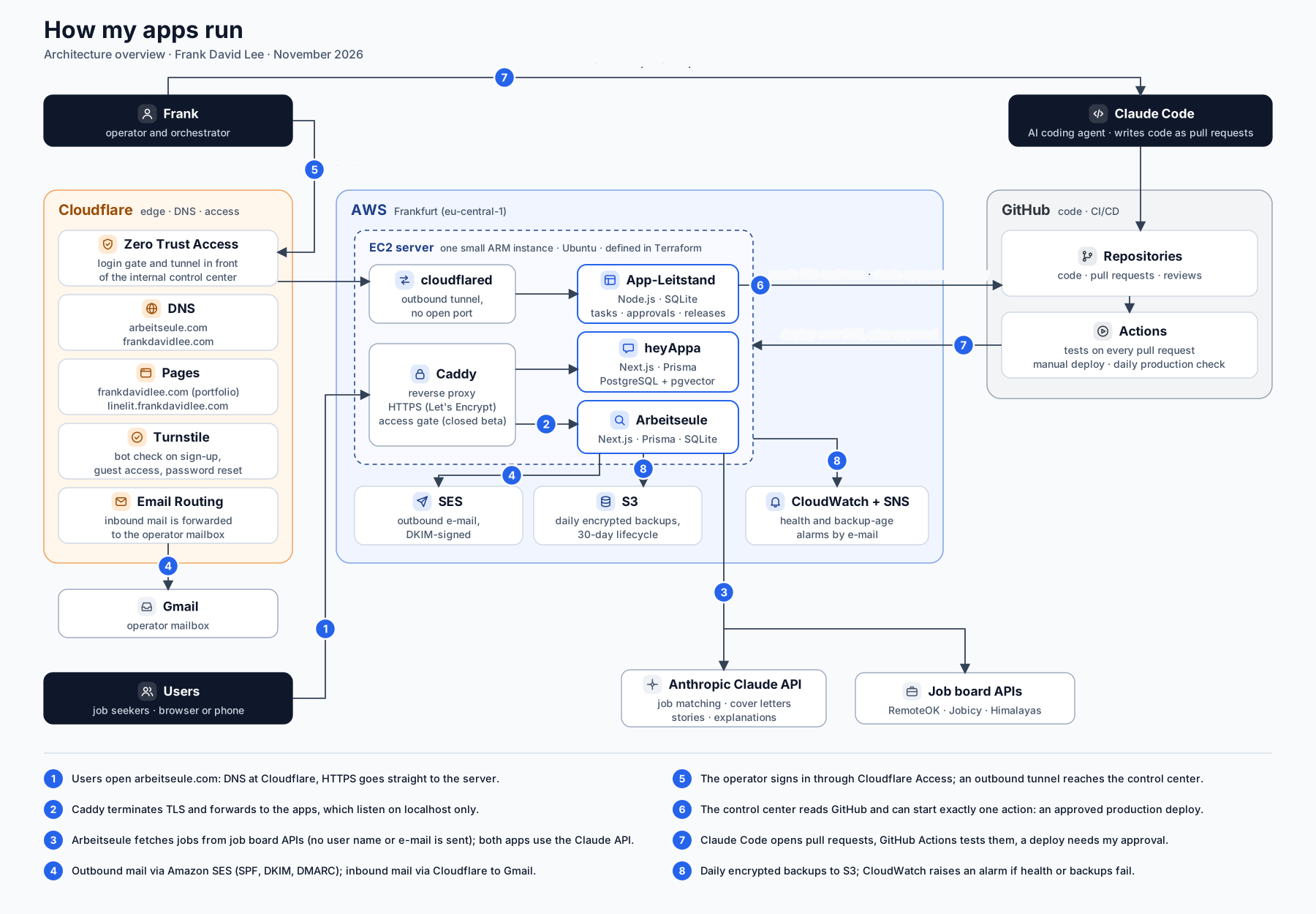
Users reach the apps over HTTPS on one small AWS server. Cloudflare guards the entrances, GitHub tests and ships the code, and backups and alarms run on their own. Pick a number to follow one path.
A user opens arbeitseule.com.
Cloudflare tells the browser where the server is. The connection itself goes encrypted, straight to the server.
UsersDNSCaddy
Caddy takes the request.
Caddy handles the HTTPS certificate and forwards the request to the right app. The apps themselves cannot be reached from outside.
CaddyArbeitseuleCaddyheyAppa
The apps fetch jobs and use AI.
Arbeitseule fetches jobs from job board APIs; a user's name or e-mail address never goes there. Matching and cover letters run through the Claude API. heyAppa uses the same API for stories and explanations, capped by a daily budget.
ArbeitseuleJob board APIsArbeitseuleClaude APIheyAppaClaude API
E-mail takes separate routes.
Outbound mail is sent by Amazon SES, secured with SPF, DKIM and DMARC. Inbound mail is received and forwarded by Cloudflare.
ArbeitseuleSESEmail RoutingGmail
The control center has no open port.
I sign in through Cloudflare Access. A tunnel that the server opens itself provides the connection.
FrankZero Trust AccesscloudflaredApp-Leitstand
The control center reads GitHub.
It sees pull requests and test runs, read-only. It can write exactly one thing: start a deploy that I approved for one specific revision.
App-LeitstandGitHub
New code arrives as a pull request.
I describe what should be built. Claude Code implements it, GitHub Actions tests it, and it only ships after my approval.
FrankClaude CodeRepositoriesActionsEC2 server
Backups and alarms run on their own.
Every night an encrypted backup goes to Amazon S3. If the app stops answering or a backup is missing, I get an e-mail.
EC2 serverS3EC2 serverCloudWatch + SNS
- apps on one small server
- 3
- open ports for the control center
- 0
- tested restore from backup
- 14 s
- alarms: availability and backup age
- 2
As of 10 November 2026
Building blocks
AWS, Frankfurt
- EC2: one small ARM server for all three apps, defined in Terraform
- Caddy as reverse proxy with automatic HTTPS
- S3 for daily encrypted backups
- CloudWatch and SNS for two alarms
- SES for outbound e-mail
Cloudflare
- DNS for both domains
- Turnstile as bot protection without tracking
- Email Routing for inbound mail
- Zero Trust Access and a tunnel in front of the control center
- Pages for this website and Linelit
GitHub
- Repositories with one pull request per task
- Actions: tests on every pull request
- Deploys only on click, with confirmation
- A daily check of production
AI
- Claude API in two tiers: a cheap model for scoring and short explanations, a stronger one for writing
- Hard limits: a cost budget in Arbeitseule, a daily call cap in heyAppa
- heyAppa computes embeddings on its own server and searches in PostgreSQL (pgvector)
- Claude Code as coding agent; through MCP, Claude reads tasks straight from the control center
What I pay attention to
Approval before production
Nothing reaches production without approval. Every approval is bound to exactly one revision of the code.
Security in layers
The apps listen on the server itself only, and the control center is not visible on the internet.
Back up first, then ship
Every deploy starts with a backup, and the previous build stays in place as a way back.
Privacy from the start
Servers in the EU, data processing agreements, no tracking cookies.
Secrets never in code
Secrets live on the server and in a password manager only, never in code and never in an AI session.
Costs small and visible
One server, free tiers where possible, a budget alarm.
Deliberate trade-offs
One server instead of many
One server is enough for the current number of users and keeps effort and cost small. It is a single point of failure. That is why there are daily backups, a tested restore and alarms.
SQLite where it is enough, PostgreSQL where it is needed
Arbeitseule and the control center use SQLite: one file, easy to back up and very fast for a few concurrent users. heyAppa needs vector search, so it runs on PostgreSQL with pgvector.
The next step when it grows
A managed database, a second server behind a load balancer and a staging environment before production. The server is already defined in Terraform; backups, alarms and mail are set up with documented scripts so far and will move there.
What runs in each app
-
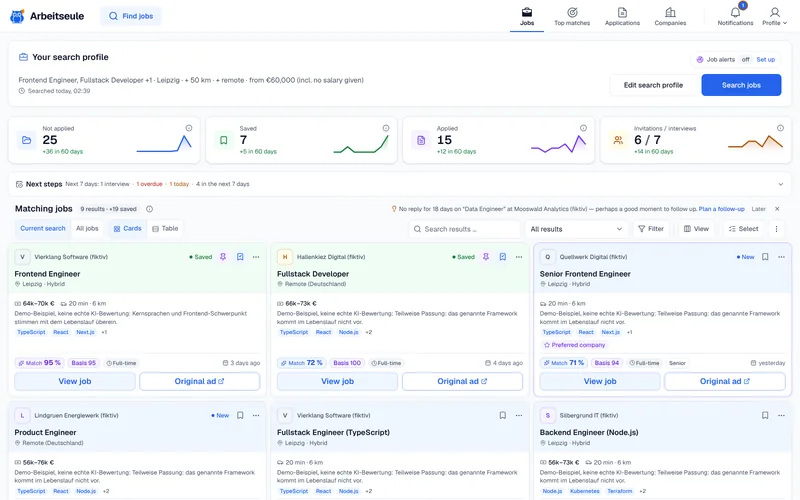
Arbeitseule
- Next.js, Prisma and SQLite – one file as the database
- Claude API in two tiers: a cheap model scores, a stronger one writes, under one cost budget
- Nightly backup to S3, restore tested in 14 seconds
- Ships through GitHub Actions, only after my approval
-
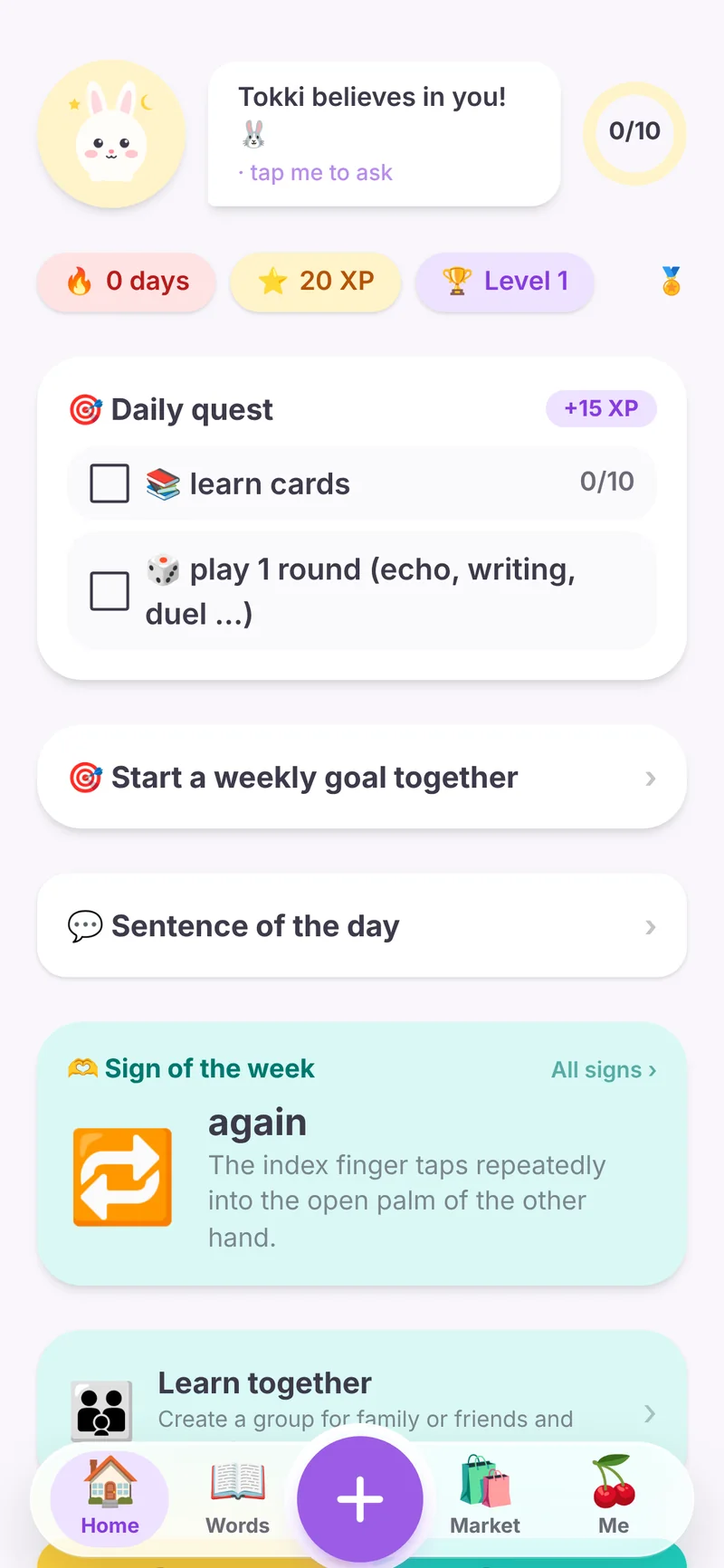
heyAppa
- Next.js, Prisma and PostgreSQL with pgvector in a container
- Text embeddings are computed on the server itself; similarity search runs in the database
- Claude API in two tiers with a daily call cap and an off switch
- Nightly database dump and voice recordings to S3; push reminders by timer
-
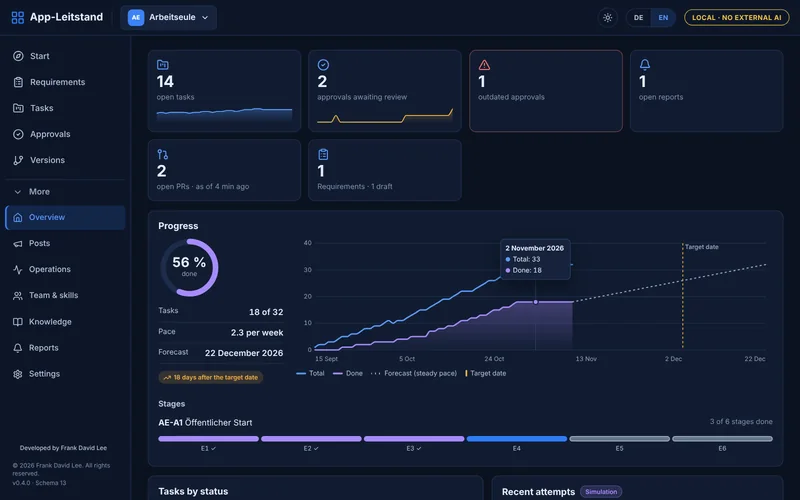
App-Leitstand
- React, Node.js and SQLite
- Reads GitHub only; the one write action is an approved deploy
- No open port: Cloudflare Access in front, and the app checks the sign-in token itself
- MCP server so Claude can read tasks and report results


Let's talk.
The fastest way to reach me is by email or on LinkedIn.
Open to roles as AI Engineer, Agentic AI Engineer, Product AI Engineer or Senior Fullstack Developer. Based in Hamburg, happy to work remotely or to relocate for the right role.